Photography and Imagery · Step 2 · 5 min read
Faces and gaze
People look at faces, then where those faces look. Three eye-tracking studies show that a face looking at the product leads attention to it, and a face looking at you keeps attention on itself. How to use that in a layout, honestly.
We look at faces first, and then we look where they look. It's one of the oldest tricks in painting and one of the best-tested ideas in advertising research. In a product, it means a person in a photo is never neutral: their eyes are an arrow, and you decide where it points.
What you'll be able to do after reading:
- Explain what eye-tracking research found about gaze direction
- Use gaze to lead attention to a product, a headline or a button
- Know when a face looking at the viewer is the right choice, and what it costs
- Avoid the faces that pull attention away from the task
1. Follow the eyes
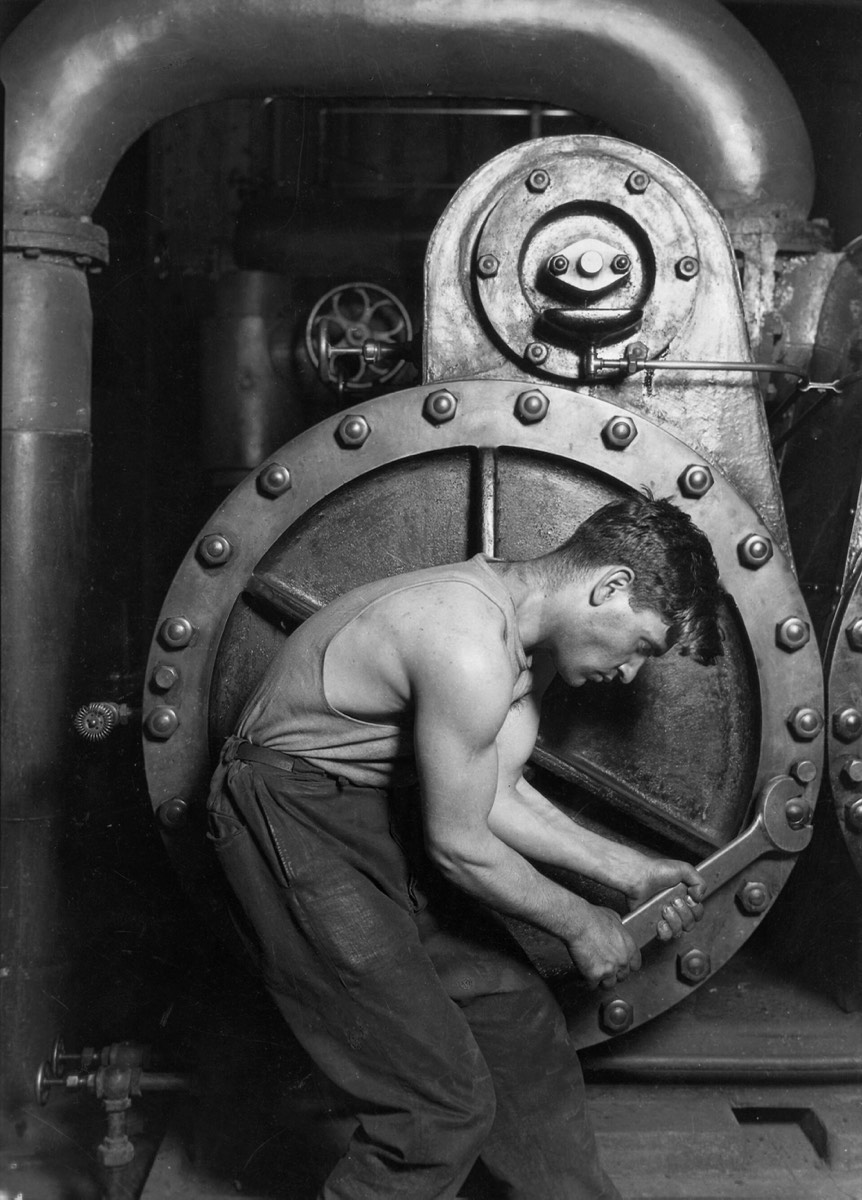 He looks at the work
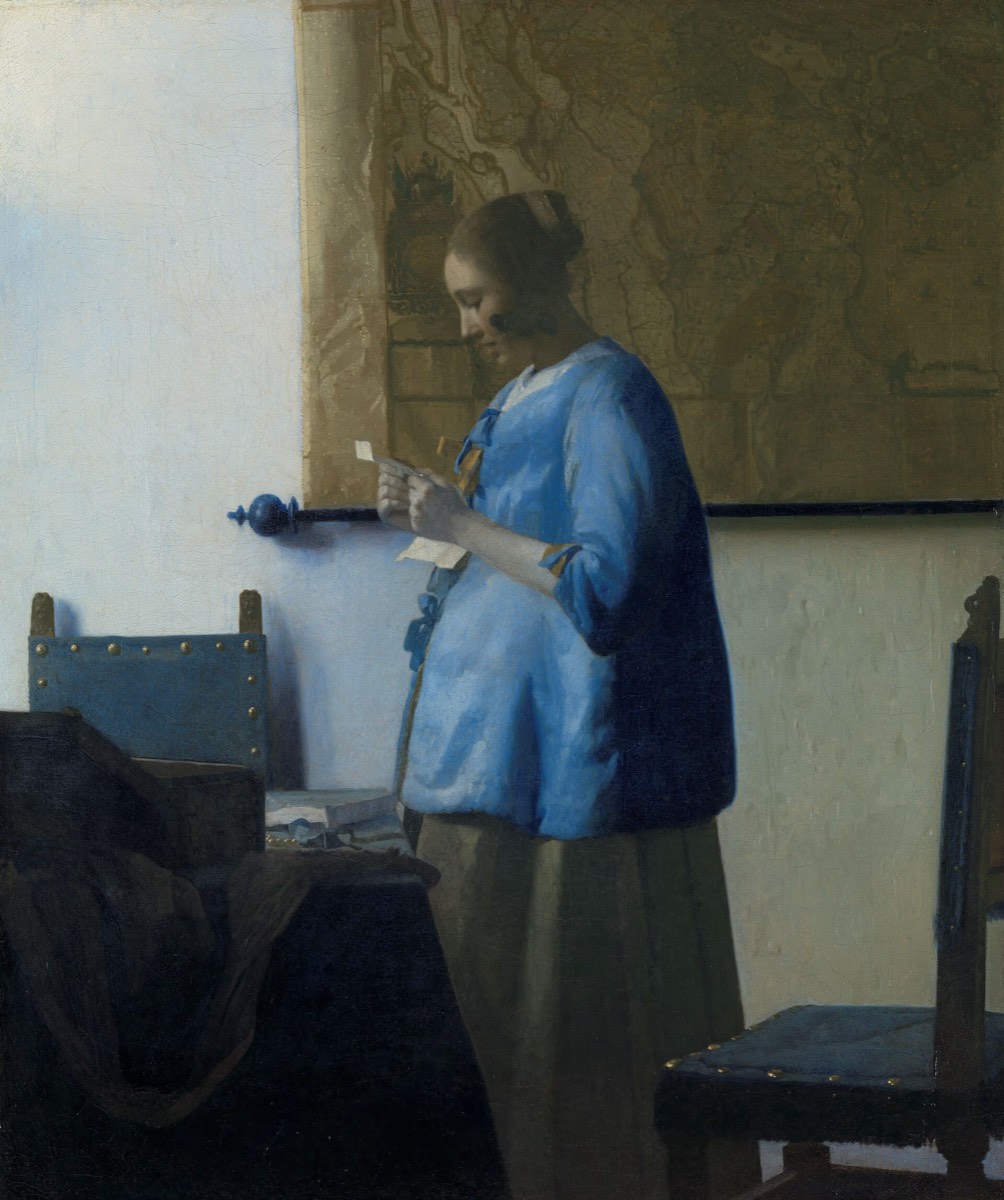 She looks at the letter


Lewis Hine photographed a mechanic in 1920 bent over a steam pump, both hands on a wrench. Vermeer painted a woman reading a letter about 250 years earlier. Neither looks at you. Both look at what matters, and so do you: the bolt, the letter. Painters and photographers have used this for centuries; researchers have now measured it.
2. What the studies found
Three eye-tracking studies, three kinds of ad, the same direction:
- Print ads. When the model looked at the product rather than at the reader, people looked longer at the product, at the brand logo and at the rest of the ad (Hutton and Nolte, Applied Cognitive Psychology, 2011).
- Web banners. Faces looking towards the product and the text drew more attention to them and improved brand recognition afterwards. Faces looking straight at the viewer held attention on the face and weakened those gains (Sajjacholapunt and Ball, Frontiers in Psychology, 2014).
- Banners and product judgements. A face looking at the product made people about 4.1 times more likely to look at it, and raised their intention to buy. It didn't make the product seem more attractive or more valuable: gaze directs attention, it doesn't create liking (Palcu, Sudkamp and Florack, Frontiers in Psychology, 2017).
3. Using gaze in a layout
- Point the gaze at what matters. If a person sits next to a headline or a button, have them look towards it, not away from it and not at the edge of the screen.
- Mind the side. A person looking left, placed on the left of a layout, looks out of the page. Flip the layout, or choose another photo; don't mirror a photo of a real person, because text, logos and faces don't survive mirroring.
- Leave room in the direction of the gaze. Photographers call it "lead room": space in front of the face. It feels natural; a face looking at a nearby edge feels cramped.
4. When a face should look at you
Direct gaze isn't wrong. It holds attention on the person, and sometimes that's the job:
- a doctor's or a teacher's profile, where people choose who to trust;
- a support or contact page with a real person behind it;
- a story told by the person in it.
What it costs is attention on everything else. On a page where the task is to read a price or press a button, a big face looking at you competes with the task.
5. Common mistakes
- A model looking out of the page, away from the headline next to them.
- A big, direct-gaze face on a task screen, competing with the action.
- Mirroring a photo of a person to make the gaze fit the layout.
- Quoting gaze studies as proof that a face will "increase conversion".
6. Vocabulary
| Term | Meaning |
|---|---|
| Gaze cue | The direction someone in an image is looking, which viewers tend to follow |
| Direct gaze | A face looking straight at the viewer |
| Averted gaze | A face looking away from the viewer, at something else |
| Lead room | Space left in front of a face, in the direction it looks |
| Model release | Written permission from a person to use photos of them |
7. Try it (no tools needed)
- Find three adverts or landing pages with a person in the main image.
- Draw an arrow from each person's eyes in the direction they look.
- Where does the arrow land: the product, the headline, the button, the edge, or you?
Reflection questions: In which of the three did your own eyes follow the arrow? What would change if the person looked the other way?
8. If you already practise
- Add gaze to your image brief: "looking at the product, towards the right of frame" is cheap to ask for on a shoot and expensive to fix after.
- When reviewing a layout with people, draw the gaze arrows on a screenshot. It's a fast, visual way to settle a debate.
- Keep the 4.1 times figure honest: it's attention to the product in a banner study, not sales.
Checklist
Learn more
- Hutton and Nolte, The effect of gaze cues on attention to print advertisements (Applied Cognitive Psychology, 2011)
- Sajjacholapunt and Ball, The influence of banner advertisements on attention and memory (Frontiers in Psychology, 2014)
- Palcu, Sudkamp and Florack, Judgments at Gaze Value (Frontiers in Psychology, 2017)
Books, courses and videos to go deeper
- The Visual StoryBruce BlockBook · 3rd edition (Routledge, 2021) (Amazon)
- Eyetracking Web UsabilityJakob Nielsen and Kara PerniceBook · New Riders, 2010 (Amazon)
Book links go to Amazon. As an Amazon Associate I earn from qualifying purchases, at no extra cost to you.
Related
Composition · Light and what it says · Crop and aspect ratio · What an image does in a product